#6 Austerity: A choice,not a necessity.

Photo: Pixabay.com

Imagine a doctor, who is treating a patient for anaemia, deciding to reduce the person’s food intake. Pretending this will be good for him, and will allow him to recover. Accusing his previous doctor of reckless mis-treatment, wasting the hospital’s resources. Think that would never happen?  

The year is 2010. Following the Financial Crash of 2008, the banks are still reluctant to lend, businesses are nervous about investing, and consumers are scared to spend. Doctor George Osborne is appointed to take over a patient’s care by new Prime Minister David Cameron. He decides that the patient, United-Kingdom-Economy, who is suffering from a condition close to malnutrition, having been badly weakened by the Financial Crisis, needs to go on a diet, and eat less. He says the hospital is short of food, and has to live within its means, balance the budget, and so on. The relatives and friends all know what it’s like to have to live within a budget, so they agree to this. What they don’t know, is that this hospital has access to unlimited food and medicines, if it chooses to use them. And, that Dr Osborne knows this, and has his own plans for the hospital’s food and medicine.

If you have read my earlier pieces in this blog, you will realise that the United Kingdom has its own currency, so can spend into existence whatever amount of pounds sterling it chooses to. Doesn’t have to “borrow” any, doesn’t have to “pay any back”, in real terms. (Bonds, and their interest are repaid when they mature, but as this is done in £sterling, and we have complete control over how many pounds sterling we have access to, it’s not like debts as you or I understand them. See #4, deficits and debt.) But we have been repeatedly told that “there’s no magic money tree”, that Government “borrowing” is dangerously high. That “fiscal responsibility” is important. That the UK could “go bankrupt”. So, budget cuts had to be made, public spending had to be reined in, the wages of public sector workers such as nurses, police officers, fire-fighters, binmen, etc, had to be capped. As Alexei Sayle’s bitter joke went, we were told that “the Financial Crash was caused by too many libraries in Wolverhampton”. The previous government was alleged to have caused the banking crisis by its reckless spending. (Forgetting that the crash was caused by the greed and irresponsibility of the banks and financial services industry, who had been saved from catastrophe with an injection of funds called “quantitative easing” by Gordon Brown’s government, which then merely maintained normal public expenditure).

So what happened between 2010 and today?  Huge and savage public spending cuts.  Not challenged by the papers and TV news, who accepted the official story, and faithfully relayed that to a public who understood very little about economics. (What little they did know was based on an utterly false picture painted by the Monetarist School since the 1970s, which most people still believe). here’s what happened to wages:
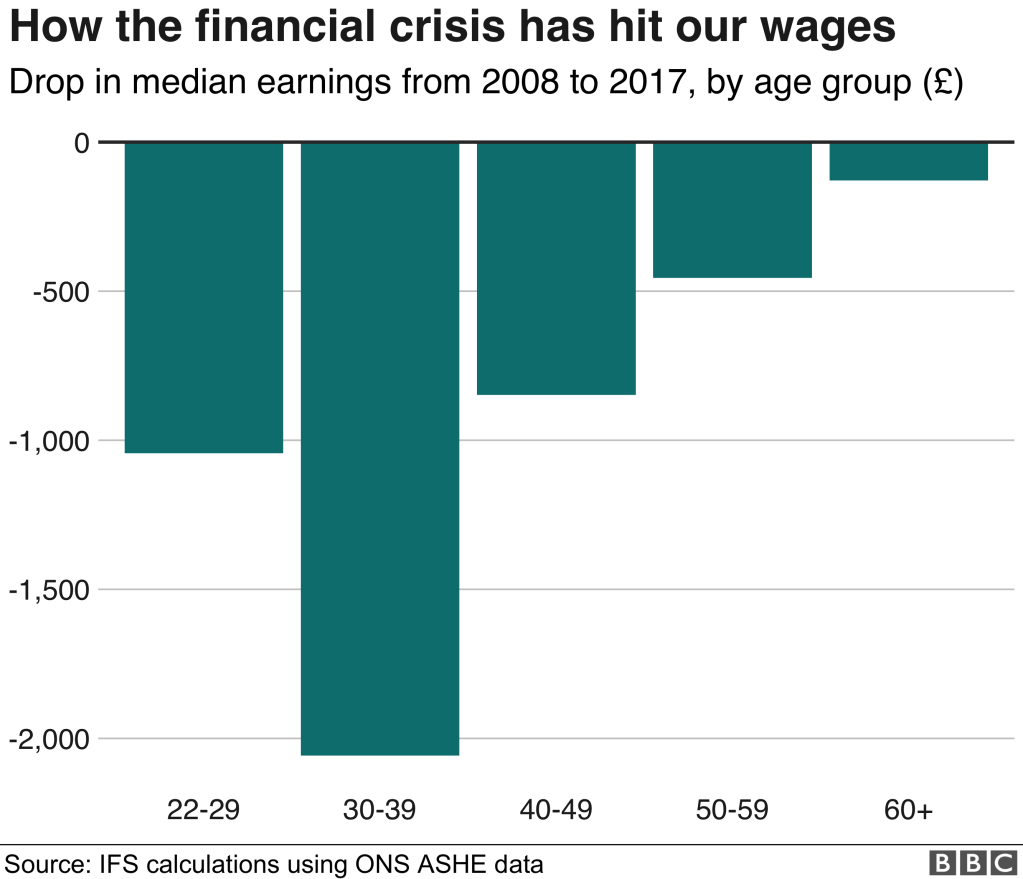
Public sector workers are no better off in real terms, than they were in 2009. Police officer numbers were cut by 20,000. Council government support was cut by £billions, so councils had to make reductions in the services they were obliged to provide to the public. The funding of schools was cut so much that today, teachers buy stationery for the pupils to use out of their own pockets, class sizes have risen, and staff are demoralised. Fire stations were closed, and staff numbers cut. Legal aid was severely restricted, so poorer people didn’t have help to get fair access to justice.

As zero-hours working increased (now approximately 1,000,000 people), and many were forced to rely on precarious self-employment, this combined with wages being kept down, to cause widespread in-work poverty, on a scale not known since the 1920s.
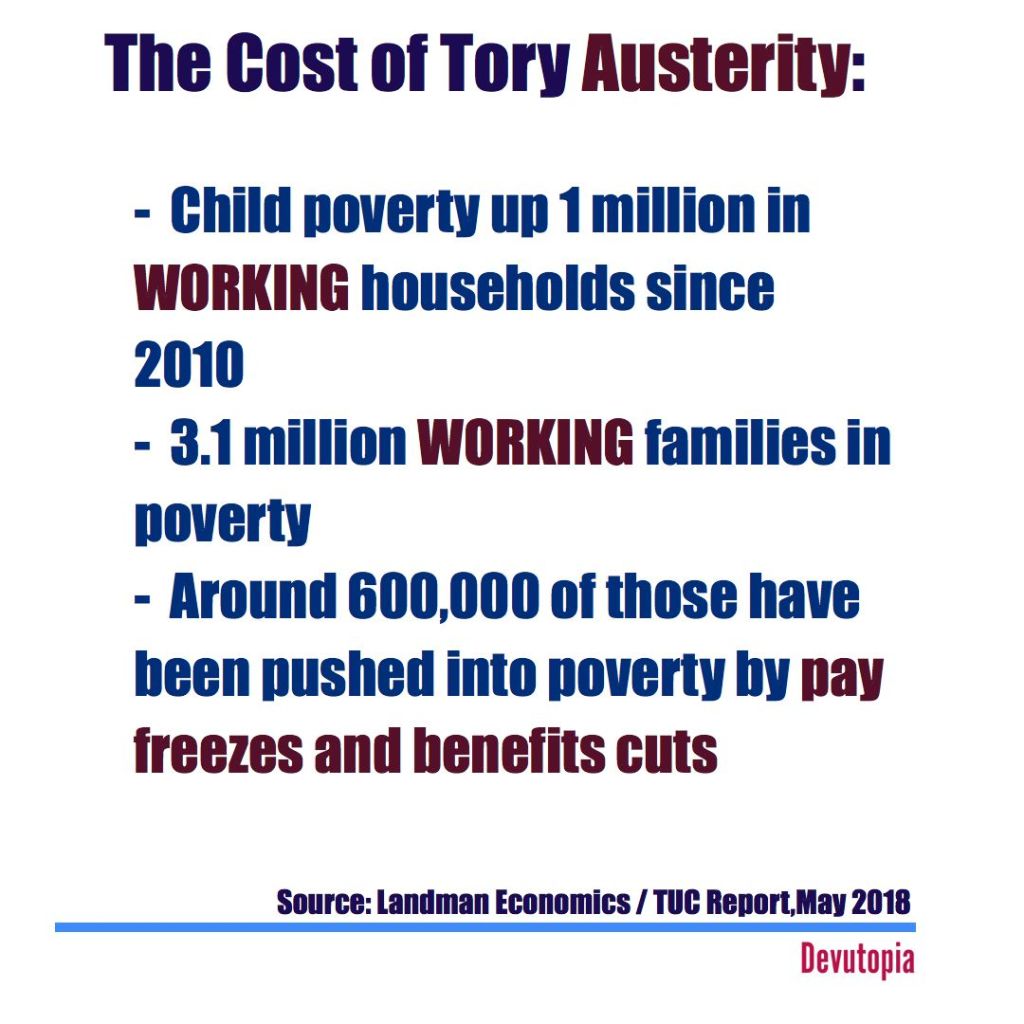
This, together with a 1920s-style harsh benefits regime, including the notorious Universal Credit, (dressed up as “Welfare Reform”), means  we now have more foodbanks providing a lifeline to those in real poverty, than the total of McDonalds and Burger King restaurants combined. Even welfare benefits to support those with severe disabilities, have been withdrawn, often by corrupt means.

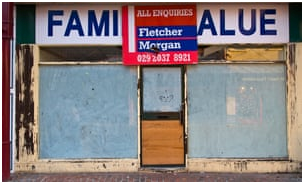
I could mention many other serious effects on society, but it’s time to consider what effect that all this reduction in public spending has had on the overall economy. Put simply, when a government takes £billions out of an economy, it tanks. People struggle to pay bills, with, for many, little or nothing left over to spend on clothing, household stuff, eating out, gifts, toys, etc, etc. Once prosperous High-Street giants (Toys-R-Us, House of Fraser, Maplin, Debenhams, restaurant chains, and others) have either gone bust or had to reduce staff and close shops. Not just because of the move towards internet shopping. Many towns in less prosperous areas, have many boarded up shops, and little else besides charity shops, cash-converters-type businesses, and pound shops- and even the pound shops are struggling. Unless you live in the wealthier parts of the South-East or South-West, you will know what I am talking about.

So, what happens to tax revenue, when many people have reduced wages, so they pay less income tax? When less goods are sold, so less VAT is paid? When businesses fold, putting people out of work, and paying less business taxes? When large businesses that do survive, make less profit, so pay less Corporation Tax?  As I explained in #4 here, the “budget deficit” is (put simply) the difference between what a government spends and how much it claws back in taxation. So today, we have a (relatively) huge budget deficit, with nothing to show for it.  Except either reduced living standards, or actual hardship.

All this economic vandalism, is what happens, when governments, aided and abetted by “journalists” who should know better, persuade the people that a government’s financial management is like that of a normal household, so they have “budget constraints”. That we “can’t afford” proper public services. That we “can’t afford” to pay student nurses while they are training. That support for the sick, disabled, and old has to be paid for out of taxes, so we “can’t afford” it.  That we “can’t afford” to pay fair wages to essential workers, such as emergency services staff.

A government with its own currency and Central Bank, such as ourselves, or the USA, or Australia, Norway, Canada, etc   can no more “run out of money” than the FA can run out of goals. Yes, it is possible in certain circumstances, for public spending to exceed the real resources (people, raw materials, energy) to provide what a country needs, which could cause inflation. But the UK is nowhere near that situation. And, unless governments spend money into the economy as they should, everybody, (except the very rich) suffers.

The sad thing is, it’s not as if we shouldn’t already realise how public money really works. That governments need to provide funds, for a healthy economy. In the 1930s, following the Wall Street Crash, economist J.M. Keynes knew it, and helped to rescue the UK economy. In the 1930s and 1940s, economist Joan Robinson wrote about it. The British wartime government of 1940, and the Attlee government of 1945-1951 understood it. U.S. President Kennedy understood it in the early 1960s:


To sum up: If you have read as far as here, you will now understand why austerity policy is a political choice, not an economic necessity.

And always remember- No Government ever cut its way to prosperity.

(photo: Jeff Morgan08/Alamy)
I am grateful to Malcolm Reavell for his input on some points in this chapter.


#5 The rigged housing market

It has been reported that if the rise in the cost of housing over the last 30 or so years was the same for everything, a loaf of bread would be £10, a litre of petrol £13, an oven ready chicken £50. Imagine the outcry, rioting… but many seen to just accept with resignation the scandalous cost of buying or renting a home, an equal or greater need. Partly because, I suspect, many already own a home, and most of those bask in the satisfaction of seeing its vastly increased value.

John Harris in the Guardian: “…….housing is a central issue, and always has been. The nitty-gritty of politics is often reduced to the cliche of “schools and hospitals”. But think of the aftermath of each world war, and the great steps forward marked by the concerted building of council houses…….

And let’s not forget: it was housing that tipped the world into the crash of 2008, when the banks finally confronted the lunacy of sub-prime mortgages, essentially a replacement for the public housing the US – and the UK – had forgotten how to build.”

“According to research commissioned by the National Housing Federation (which represents housing associations), 3.6 million people in England are living in an overcrowded home, 2.5 million are unable to afford their rent or mortgage, and another 2.5 million are in “hidden households” they can’t move out of – including house-shares, adults living with their parents, or people living with an ex”.

Rates of home ownership among the under-35s are at less than half the levels of 20 years ago. Homelessness, both visible and hidden, has become a grimly mundane part of life. A million families are stuck on council waiting lists; in 2017-18, a pitiful 6,463 units of social housing were built in England, down from 30,000 a decade before.”

Let’s look at arguably the strongest factor influencing this insane rise. Cast your mind back to the Thatcher era.  If, then or now, you are a seller of goods that everyone needs, but there is a plentiful supply of those goods, and other successful sellers,  then you are only going to make a modest profit. Now, imagine you are a large house-building company. You are making a profit, but a lean one, and you would like to bump that profit up.

Your biggest competition is the fact that millions of people can rent a good-standard home at a reasonable rent from their local council, so they don’t really need to buy one of your houses or flats. Suppose you hit on the idea of persuading the Government of the day to reduce the supply of these council homes. You make some big donations to ruling-party funds, and suggest council tenants be given the right to buy their homes at a discount.

The bonus for the ruling party is that the lucky former tenants will be thrilled to be able at last to buy their own piece of real-estate, and will be grateful to that government at the ballot box. So Thatchers’s government does just this, making a soon-to-be-forgotten promise to build new social homes to replace those sold. (Actually, I’m not sure whether the developers suggested the scheme to the Thatcher Government.  Or, some Conservative strategist came up with the idea as a vote-winner, and the developers said  ”Wow, fantastic, happy days, here’s a helping hand for your campaign funds”. See note below.

But, the result was the same. Note, what follows would not have happened if Thatcher, and subsequent governments, had kept the promise to build replacement council homes for each home sold under Right To Buy(RTB). They didn’t.

Over the next 30 years the number of council houses built steadily declines, with a very rapid decline from 2010 as the Conservative government refuses to allow even Labour or other councils, or housing associations, to raise finance to build or acquire houses in any significant number.(Blair’s government,1997-2008, to its shame, did nothing like enough to counter this. It was too keen to continue with the nonsense of “budget constraints”).

 Naturally, the price of houses and flats rises steadily, helped by a rise in the population and number of households in that population. Because now, there aren’t enough homes to go round. (This process was also made made even easier by Thatcher-era de-regulation of the banks, and global finance trends, which resulted in greater and cheaper mortgages being easily available.) It becomes highly profitable for companies, or individuals, to buy homes to rent out, because if the cost of buying homes goes up in a time of shortage, so does rent.

So, we now have a situation where the cost of renting or buying a home gobbles up a huge proportion of people’s income. Not to mention the misery of homelessness, or living in sub-standard accommodation. In Bristol, for example, today, there is strong competition to take even the vastly-overpriced flats offered for rent, which detracts from the ability of businesses to recruit staff there. They often either commute huge distances from cheaper areas, increasing traffic congestion and pollution, or live in the “grey” housing market. This is living in old caravans, vehicles, boats etc. Bristol is just one example of the problem in many cities in the UK, indeed in most of the South of England.

And, it’s worse than that, by a long way. If a large number of people are spending most of their income on their home, plus council tax, utilities etc, they have very little left to devote to even modest expenditure on clothing, eating out, cinema visits, other purchases, etc,  etc.  Hardly surprising that formerly successful and profitable large businesses, such as Sports Direct, House of Fraser, Pizza Express, Thomas Cook, and many others are either struggling to survive, seeing profits shrink, going under, or shedding staff. Those redundant staff, or those on zero-hours contracts, now have even less money to spend, so more businesses suffer.

This has combined with ruthless suppression of public-sector wages over the last 9 years of Conservative Government, claiming “budget constraints”. If you have read my earlier pieces in this blog, you will realise that this is economic nonsense, a fairy-tale which the media have encouraged for many years.

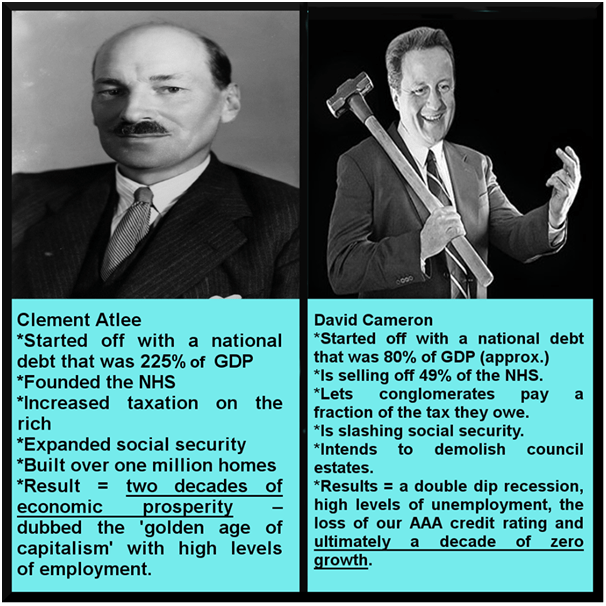
By contrast, look at what happened under the Attlee Labour government of 1945-1951. A decision was made to bring about the building of hundreds of thousands of council houses, and a programme commenced that would continue well into the 1950s and beyond. This was partly because of the urgent need to house returning service-men and women, many of whose homes had been destroyed by bombing, or who had been living in squalid pre-war slums. The “baby-boom” was happening, (I was one of those babies!), and young families needed decent homes.

But I believe that Attlee’s government also realised that a council-house building boom would mean thousands of good-quality jobs– the building trades, the designers, the administrators, the materials suppliers/transporters/merchants, etc, etc. And all those jobs would boost the economy generally, helping to create a prosperity which would benefit the mass of people, not just the already-rich. Those lucky enough to become council-tenants at reasonable rents, and with decent jobs, had some money left over each week or month to spend boosting businesses generally, which created more jobs. (Not, stash it away in the Cayman Islands.)

This is a prime example of how a government that chooses to create investment-spending can transform both the economy and peoples’ lives. Contrary to what the “experts” and media are always telling us, “deficits” need not be anything to worry about!

Note: re sale of council housing policy: the sale of council homes to tenants was not a new idea, it had been suggested by Labour in 1959, and by the Conservatives in 1970. (Here’s Dr John Docherty in a letter to the Guardian, “Andy Beckett describes right to buy as a “Thatcherite” policy. It was Hugh Gaitskell’s 1959 Labour manifesto that pledged that “Every tenant will have a chance to buy from the Council the house he lives in”. Then Ted Heath’s 1970 Tory manifesto promised to encourage local authorities to sell council houses to their tenants so that “tenants of today will become the owners of their own homes tomorrow”. But, as Dr Peter Estcourt replied to that, “Under Labour the money raised was to be used to improve existing stock and add new builds. Under Mrs Thatcher a large taxpayer-funded subsidy was granted and most of the money raised was diverted to the Treasury. Local government was forbidden to use what little money it was allocated in the council housing sector.”

Of course, all housing is politics, because all politics is competition for resources.” From an article in Thejournal.IE about the rigged housing market in Ireland. You can read it here.

Further reading: A new article in Tribune magazine, in April 2022, looks at the subject of how housing costs are threatening UK society, and why. As Joe Bilsborough writes, “In England in 1949 close to 140,000 council houses were built. In 1999 this number was fifty. Solving the housing crisis requires not just reversing these trends, but re-embedding and re-asserting the vision which ……… has long defined social housing: ‘the visible manifestation of a state which took seriously its duty to house its people decently.’ Read the full piece here.

For a fascinating, thorough history of council housing in the UK, from Victorian slums to Grenfell Tower, John Boughton’s “Municipal Dreams” is outstanding.

For more information about the “National Debt”, see my piece #3 in this blog. 

4. “Who’s afraid of the Big Bad National Debt?” The reality of deficit and debt.

We hear TV news, the papers, and politicians bleating on about “the National Debt” and “The Budget Deficit” a lot, don’t we? And, as we all know what it’s like to have debts to pay, we worry about it. We think, “how is the country going to pay for…..?” “Our children will be burdened with debt for ever…” Well, it’s time we looked at the reality.

In my second and third pieces in this blog, we realised that taxes don’t fund government spending, it’s actually the reverse. Governments (if they have their own currency, like the UK) decide how much money the country needs, and then provide it by spending it into existence. ( They also license the commercial banks to make loans, a form of money creation.) They then take some back in the form of taxation, for various reasons. (See my 3rd piece, Let’s talk about taxes). Virtually all other economic activity flows from this government money creation. And this process is often referred to as the “Budget Deficit”.

Even more confusingly, it is often called Government “borrowing”, which is nonsense. It is nothing like “borrowing“, as you or I understand it in our daily lives. If you, or I, were allowed to, and entitled to, put whatever credit figure we liked in our bank accounts, would we really go out and borrow money from anyone?

So, what actually is the “Budget Deficit”? Well, first of all, let’s realise that “deficit” and “debt” of governments, are frequently used confusingly as meaning the same thing.  Let’s start with “Deficit”.

The “Deficit” is actually the total amount of money injected into the economy each year by the government of the day, less the total tax collected. It’s not a real thing, like my or your car loan, or mortgage. It’s an accounting device. At the end of the government’s financial year, it disappears, and is replaced by the next year’s budget, not “carried over”. If a government chooses to run a “budget surplus”, this means taking more money out of the economy than it puts in, which will almost always cause a recession or slump.  Yet, many politicians talk about it as if it’s a beneficial thing, like us paying off a loan. It’s actually very destructive. (I will talk about this more in the next article, on “austerity policy”.) In the words of economist Ellis Winningham, “budget surplus is the act of the UK government reducing the number of British pounds available for people to save and to spend.”

What about the “Debt”?  Governments can, and do, “borrow” money, in the form of Government Bonds, also known as “Gilts”. Organisations, and in some cases people, “lend” money to the government, in return for a guaranteed repayment, and modest interest. For historical reasons, mainly to control interest rates, governments have sold Bonds equal to the amount of new spending which is over and above its receipts. But this is nowadays really a case of the government providing a safe place for spare cash to be placed, because, in the words of an Australian blog, “Monetary sovereign governments do not need to borrow, and when you understand the monetary system fully, you understand that they do not borrow in a meaningful way at all (as long as they never borrow foreign currency).You can’t meaningfully borrow the tokens you yourself create. You certainly don’t need to do so.”

In the current circumstances, (April 2020), the world’s financial markets are in freefall, so it would be impossible to sell Bonds to anything like the huge amounts that need to be spent. If necessary, the Bank of England just creates money to, effectively, buy these Bonds from itself. I

The “National Debt” figure also includes the amounts people have saved in National Savings and Investments, which includes such things as Premium Bonds. To call these savings “debt” for a UK government, is, as Professor Richard Murphy of taxresearch.org says, grossly misleading. The savers wouldn’t want them “repaid” or paid off, unless they have actually asked to cash them in!

So, how much do we need to worry about the National Debt?  Not much, actually. In the words of Richard Murphy “a government that only borrows in its own currency cannot, as a result of this understanding, ever default on its own debt because it can always issue the instruction to its central bank that the payment of that debt be settled.”

President John F. Kennedy understood this, back in the early 1960s: “Is there any economic limit to the size of the debt in relation to national income? There isn’t, is there?….That’s right, isn’t it? The deficit can be any size, the debt can be any size, provided they don’t cause inflation. Everything else is just talk.” JFK to James Tobin. ( James Tobin (March 5, 1918 – March 11, 2002) was an American economist who served on the Council of Economic Advisers and the Board of Governors of the Federal Reserve System, and taught at Harvard and Yale Universities-Wikipedia.)

Those who believe that governments need to raise money by issuing bonds, might be surprised to learn that in Japan, bond yields are negative. That means that the Japanese Government pays no interest on its bonds, in fact the reverse. Organisations acually pay the Japanese Government to store their unused money.

I realise this all sounds a bit shocking, because we have all been conditioned to think government finance is like our own finances. But, think about it: if you were allowed to put as much money into your bank account  as you liked, would you worry about paying off debts? The UK government is not only entitled to create money, but has to. And does not allow anyone else to.

Why might a government want to let people/voters think that the UK budget is like our own household budget?  Because it may well suit their  political agenda. We will look at this in more detail next time, when examining “austerity” policies.

Here’s Mike Hall, of the Facebook group MMT for the British People, 13.02.2020 :

“In reality, when they’re in power, and just like US Republican Party, the Tories don’t care about Gov deficits. Despite all the propaganda media guff that they do, their policies never change because of deficits.
When convenient as an excuse, deficit hysteria is invoked, and when it isn’t deficits are ignored, and mass media oblige likewise.”

I will wrap up this bit by giving us two contrasting statements  to consider. Firstly, from former Chancellor George Osborne:

“If we don’t get a grip on government spending, there will be no growth”. George Osborne Read more at: https://www.brainyquote.com/quotes/george_osborne_464526

Then this:

Note: I have, of course, rather simplified a very complex subject, but not so as to mislead. In actual fact, the term “National Debt” is a rather vague term, and nobody- not even professional Economists- can really define it accurately. To explain why, this video, by Chartered Acountant & professor of Political Economy Richard Murphy, tells you how impossible it is to find out exactly what “National Debt” is, even from official sources. https://www.youtube.com/watch?v=oXwmRDM6InI

I am grateful to Catherine York for proof-reading, and her support.

3. Let’s talk about taxes

#3     Let’s look at Tax-why is the economy like a washbasin?

In #2, we looked at how we have all been led to believe that Governments spend “taxpayer’s money”, and can only afford to spend what they receive in tax receipts, because it’s convenient to justify political agendas. “There’s no magic money tree, dear”, Theresa May told a nurse who asked why they were only getting a very small pay rise, in 2018. What’s the real story about tax? What is taxation really for?

We worked out, in #1, that tax receipts are not something any Government, with its own currency, needs in order to spend on all the things Governments provide for their people. So why do governments have taxes? Well, first of all, if you are a government with your own currency, such as pounds, dollars, roubles etc, you can create/issue whatever money your country needs, but to do that, you need to make your currency the one that everybody uses.

Then, if you are a nation’s government, you need people to work for you. You will need teachers, health service staff, transport planners, police and courts, armed services, administrators to organise it all, etc. You’ll need to pay them to get them to do it, so you pay them in your tokens (pounds, in the UK). To make them need your tokens, you will have to make them pay your taxes, by law, and only accept pounds in payment of these taxes. Not Yen, bitcoin, nectar points, or turnips. Similarly, if you need contractors to build roads or hospitals.

Let’s recap on how money is created. A Government decides (“fiscal policy”) how much money its country needs to provide all the public services they need, and everything that goes with that. Plus defence, social security, pensions, etc etc. The government then orders the Bank of England, via the Treasury, to put suitable numbers on a spreadsheet, so the Bank can issue it.

Issue of pounds by the government is often, misleadingly, described as “borrowing”. Government Bonds are just an accounting device. See #11 in this blog for more details.

It can also authorise other banks to create a certain amount of money to lend to businesses and people, in the same way. It can also control things like interest rates, and under what terms banks can lend (“monetary policy”).

Okay, if we agree on that, what else are taxes for?

Governments such as the UK’s, can create as much money as they choose, and stimulate the economy. But, what happens if the country gets to a point where everybody who is capable of working is fully employed?  A long, long way off, currently. And  there is no ability to create any more goods and services for people to buy? If raw materials to build hospitals etc, have run out? All measures to reduce climate change have been taken?

A government can in those circumstances, vary the amount of taxation to reduce (claw back) some of the amount of money in the general economy. If the people have, in effect, too much money to spend, putting pressure on prices, taxes can reduce that a bit to balance things up or “dampen down demand”. (Not the current price rises, caused by supply shortages, which are largely a consequence of the pandemic. Shortages of goods, some workers, energy, shipping containers, etc. These are nothing to do with too much money.)

Sounds odd? Think of it as a washbasin with water (the economy) in it. The water (government-created money) comes from the tap, and the government controls the tap. The waste plug is used to drain excess water off (tax), to prevent the basin over-flowing.  The water (money) drained off goes down the drain. So, in the UK, and similar countries, the money that governments take in tax is simply cancelled on the Treasury master spreadsheet (the same one that money is created on). It is not actually paid out to anyone. “Taxpayers money” doesn’t really exist.

Pretending that it does is very useful, if you are a government that wants to pretend that the country cannot afford to pay fair wage increases to nurses, or other things.

Now, apart from making people trade in pounds sterling, obtaining labour and materials for public services, and countering potential inflation, what else can a government use taxes for?

Taxes can be used to encourage more fairness in the economy, or tax concessions can be used to encourage particular industries to develop, or regions to attract new industries. So for example, people on high incomes are taxed at a higher percentage rate than folk on low incomes. The most wealthy can be taxed heavily, to weaken their power to dominate policies and markets.

Taxes can also be used to persuade people to do certain things, or not do things. For example, tobacco can have its tax duty increased, to discourage smoking. In Denmark, the government wanted to make people use bicycles or public transport more, so the fees for registering a vehicle were raised substantially.

In the words of economics teacher Ellis Winningham:

The question, then, for tax policy is, “What kind of society do the people want?” and then once the voters speak, the UK government aims its spending and tax policies towards creating and maintaining that kind of society.”

This may not happen, though, if a government wants to pursue its own agenda, (such as weakening the NHS to pave the way for privatisation) and can convince the voters that it is acting in their best interests.

I am indebted to the writing of Ellis Finningham, and the economist John Harvey, for much of the material in this article.  

2. There is no such thing as “taxpayers’ money.” Why?

From the early 80s, the idea that Governments can only spend what they receive in tax, was heavily promoted, especially by UK Prime Minister Mrs Thatcher. She famously said, in 1983, “We know that there is no such thing as public money“, and added “there is only taxpayer money“.

“To most of us, the idea that the Government must tax more to spend more probably sounds reasonable“, as Professor Kelton puts it in her bestselling book. Because we all understand “budgeting”. But let’s think about it.

Almost all of us have an average income of, say, £x per month, and  outgoings/expenditure of say, £y per month. If £y is less than £x, then happy days, we’ve got more to spend next month. If £y is more than £x, we have to spend less next month, or borrow some. We’re all familiar with this, so it has been easy to convince us that government money works the same way. I used to believe it too, once. It has been called, handbag economics”.

Why governments, (and famous economists who serve them) choose to deceive the public, to suit their own political agendas, is explained in my later blog pieces, such as #6 Austerity: A choice,not a necessity.). Or, put another way:

However, like all successful advertising slogans, the phrase ‘tax-payer’s money’ invokes what psychologists call a schema…. a whole body of emotions, experiences and knowledge which mediate our response.”

“Hence, ‘Tax payer’s money’ is intended to create a direct link between government spending and the individual.  You are invited to visualise your hard-earned pennies being frittered away unwisely ……. which is hugely convenient for a politician intent on running down public services, so that they can be privatised.  Also implicit in the schema is the threat that if the government spends more, you’ll have to pay out, depleting even more of your income”. Read more here.

But, the idea that any UK Government receives tax income, puts it into an account, and then spends from that account, is just false. It doesn’t work like that, for a government with its own independent (sovereign) currency, and its own central bank (Bank of England).

So, where does public money actually come from? It’s created by governments, by spending it into existence. If they didn’t, there would be no money in the economy for public services to be provided, public buildings, roads, the NHS, businesses to grow, or people to spend or pay taxes.

Still think it comes from everybody earning money in various ways, spending some of it, and paying tax with the rest? That went out with the barter system, hundreds of years ago, if indeed, it ever existed. We can’t dig money up from the ground, or grow it in fields, and if we hire an industrial unit and manufacture our own, the police take a dim view. So, it is created by the State.

(Yes, commercial banks play their part in this. They are licensed by governments to lend money to their customers for such things as consumer purchases, or business finance. This acts as a sort of “gearing”, which allows the economy to grow, jobs to be created, etc, but all that is based on the initial injection of money by governments. More detail on this here.

How? The money governments create is spent into existence on things like the NHS, schools, Police, Courts, the Civil Service, Armed Forces, etc etc. Much of that goes on wages, which are spent to sustain lots of other businesses. Or, on materials needed for these, which creates more companies, jobs, etc. Part is given to councils to help pay for all the services they provide, because council tax isn’t anywhere near enough. Some goes on social security, so that people with no access to income, have some money to spend (remember, benefits tend to be spent on buying goods & services, not stashed away in the Cayman Islands!).

How is it “spent into existence”? By the Bank of England (BoE) marking up the balance in the accounts of those who are receiving the money. With their computer keyboard, simple as that. If, for example, state pensions are paid, a pensioner’s bank account is credited up. If you pay some tax, your account is marked down. If the Government decides to build a big new bridge, the BoE marks up the Department for Transport account, and the DfT marks up the contractor’s account.

A government with its own currency, such as the UK, can create/issue as much money as it chooses to. Or, not to.

The media talk about “printing money”, but that is nonsense- when you go to the bank for a car loan, they don’t go to the vault and bring back a big sack full of banknotes. They press a few keyboard keys, and it appears in your account. (No, it’s not taken from other people’s savings or deposits, it is just created. Economists call this “endogenous” money). The Government of the UK, effectively, does the same, via the Treasury and the Bank of England. (Just as Sainsbury’s don’t “print” Nectar points, they issue them electronically.)

So how does a Government avoid an excess of money in the economy? By taxation, which acts like a regulating valve, which prevents the economy from over-heating. Amongst other things, It regulates the amount of money sloshing around, and under-pins the economy. It can be used to damp down demand, if for a while, if there aren’t enough people/materials resources to be utilised. My third piece, “Let’s talk about taxes”, explains this more, and talks about what else tax does. But remember, taxation is not a government’s source of money to spend.

The money collected in tax is just cancelled on the master balance-sheet, the same one that is used to spend. It is not, actually, saved up in some account, from which it is later spent. It is simple double-entry book-keeping, essentially.

If you are uncomfortable with the realisation that the UK Government can spend as much as it chooses to, you may be glad to hear that there is a situation where Governments need to rein in spending, or take back money through taxation.

When is that? It is when:

*Everyone who is capable of working is fully employed for an appropriate number of hours at fair pay

*All reasonable demand for health and social care is met promptly and to a high standard

*Education is available, free, to a high standard

* There is enough decent, affordable housing to go round.

*There is still enough bricks or other stuff needed to build houses, hospitals, roads, etc.

*Energy consumption and pollution have been reduced to a minimum, by conservation and “green” generating.

This list doesn’t cover everything, but once all these are in place, excess government spending into the economy might cause demand which cannot be met, which could result in high inflation. Ain’t gonna happen anytime soon, though, is it?

To recap, a country, with its own currency, (not tied to the dollar, yen, gold, etc) can just order its central bank to spend money into existence. To finance investment, or proper funding of public services. And if it does, then, for example, the healthier level of public sector wages gives all those workers more to spend. So they spend it, creating more business activity, creating a healthy economy, creating more tax income, etc, etc. Giving ordinary people a better standard of living.This is what actually happened in Britain in the 1950s.

(note: the countries in the eurozone share a pooled currency, so they cannot do this individually).

So, there is actually no such thing as “taxpayer’s money”. It’s a politically convenient myth, a fib.

For a more detailed, full , but extremely clear and straightforward explanation of how government money is created, read Richard Murphy’s piece here. For the full technical, legal basis of UK government accounting, this provides it.

Further reading: This article by James A Robichaux explains in detail just how misleading and damaging the whole concept of “taxpayers money” really is. Morally bankrupt, as he says. 09.03.23.

Revised March 2023. I am grateful to David Harvey and David Vigar  for suggesting edits to the original article.

1. “But how will you pay for it?”

Long ago, most people believed that the sun revolved around planet Earth, instead of the other way around.

Today, most people still believe that a government gathers up all the money paid in taxes, and then uses that to pay for all the things that governments provide.

It’s actually the other way around-people pay tax out of the money that governments put into the economy, when it provides what the country needs.

( Unless it chooses not to, in which case you get  all the hardship and decline that comes from “austerity” policies.)

Think that’s wrong?  We’ve all been told about “taxpayers’ money” for years, so it must be true?

Well, have a little think about what happened in 1940. The government had to find a mind-boggling amount of money to provide ships, planes, armaments, servicemen, etc, etc, in order to fight the Second World War against Nazi Germany. I don’t know the actual figure, but I would guess about £500 billion in today’s money. Yes? Okay then-

Did they go to the bond markets to borrow the money? No, there could not possibly have been enough money to be had like that, even if the bond markets were functioning in the normal way.

Did they raise taxes, and then wait for the money to roll in? Of course not, it would have taken many years, by which time tax would have been paid in German Marks, after the War was long lost.

Did they outsource the war effort to some tycoon or hedge fund, believing that the “private sector is more efficient”?   Hardly, they needed to run a successful war, not be ripped off royally.

So they just authorised the expenditure. Told the Bank of England to produce the money.  Of course, it wasn’t digital in those days, but I don’t expect they actually printed pallet-loads  of banknotes. But, the process of government money creation is often called “printing money”.

What’s that? Governments wilfully “printing money” leads to rampant inflation, destroying the economy? So, was there an economic catastrophe after the War? Nonsense. In the 1950s, the UK was actually more prosperous than ever before in history.

Not in the sense that the rich got richer, though. In the sense that millions of ordinary working people, for the first time, had decent affordable housing, because millions of council houses were built.  They could go to the doctor, or a hospital, without fear of a huge bill that they couldn’t pay.  Anyone who wanted work, could get a secure job, not hired by the day, or on poverty wages. They could get a pension to live on when they were too old to work, and an allowance, called “National Insurance”, if they were sick or disabled. The railways were nationalised, and became more reliable and affordable. All these things came about because the Labour Government (1945-1951) had the vision to provide them, and created the necessary funding. (despite a “National Debt” of approx 250% of GDP) Just like the War government did between 1940 and 1945) to provide what they needed. This investment drove the whole economy.

(note: an important part of this was the launch of a drive to build a million council homes. This alone provided an enormous amount of good jobs-the builders and finishers, their suppliers, designers, planners, administrators, etc. People who now had decent wages and affordable housing were able at last to afford to spend a little on furnishings for their new homes, leisure, clothing, transport, etc. The whole economy started to boom in a way it had never done before.)

My own parents were able to buy a house in 1955. (My father had a good job as an engineer, but was not filthy rich, and my mother stayed at home to look after my sister and me.) In 1957, even Conservative Prime Minister Harold Macmillan made his famous “You’ve never had it so good” speech, in which he said:

 “Indeed let us be frank about it – most of our people have never had it so good.

“Go around the country, go to the industrial towns, go to the farms and you will see a state of prosperity such as we have never had in my lifetime – nor indeed in the history of this country.” What he didn’t mention, was that this fairer, more equal prosperity was the consequence of what the Attlee government had established.

And it was the same story in the USA, but bigger. So, still think governments can only spend “taxpayers’ money”? You’ll be telling me the Sun revolves around the Earth next.

Note 1. I know, there was an actual debt, in dollars, to the USA & Canada for the armaments, ships etc we bought from them, that did have to be repaid, because the goods were priced in dollars, not pounds. But this debt was managed so that it never became a burden, and did not prevent the UK becoming prosperous.

Note 2. For further study of how the WW2 government understood policy and finance, here is a link to Lord Beveridge‘s 1944 book, “Full Employment in a Free Society”: (with thanks to Malcolm Reavell)

http://pinguet.free.fr/beveridge